Generative design of molecular materials
Flow matching models for property-guided molecule generation and molecular crystal structure prediction
Designing new molecules and molecular materials with target properties requires searching a vast chemical and structural space. At the University of Florida, I develop flow matching generative models that sample 3D molecules and molecular crystals directly, and that can be steered toward desired properties. The work so far has three parts: property-guided molecule generation (PropMolFlow), guidance strategies for conditional generation (MolGuidance), and crystal packing prediction for molecular crystals (MolCrystalFlow).
PropMolFlow: property-guided molecule generation
PropMolFlow uses flow matching parameterized by an SE(3)-equivariant graph neural network to generate 3D molecules conditioned on target molecular properties. It is competitive with state-of-the-art diffusion models across a range of molecular properties while maintaining high structural validity, stability and sampling efficiency.
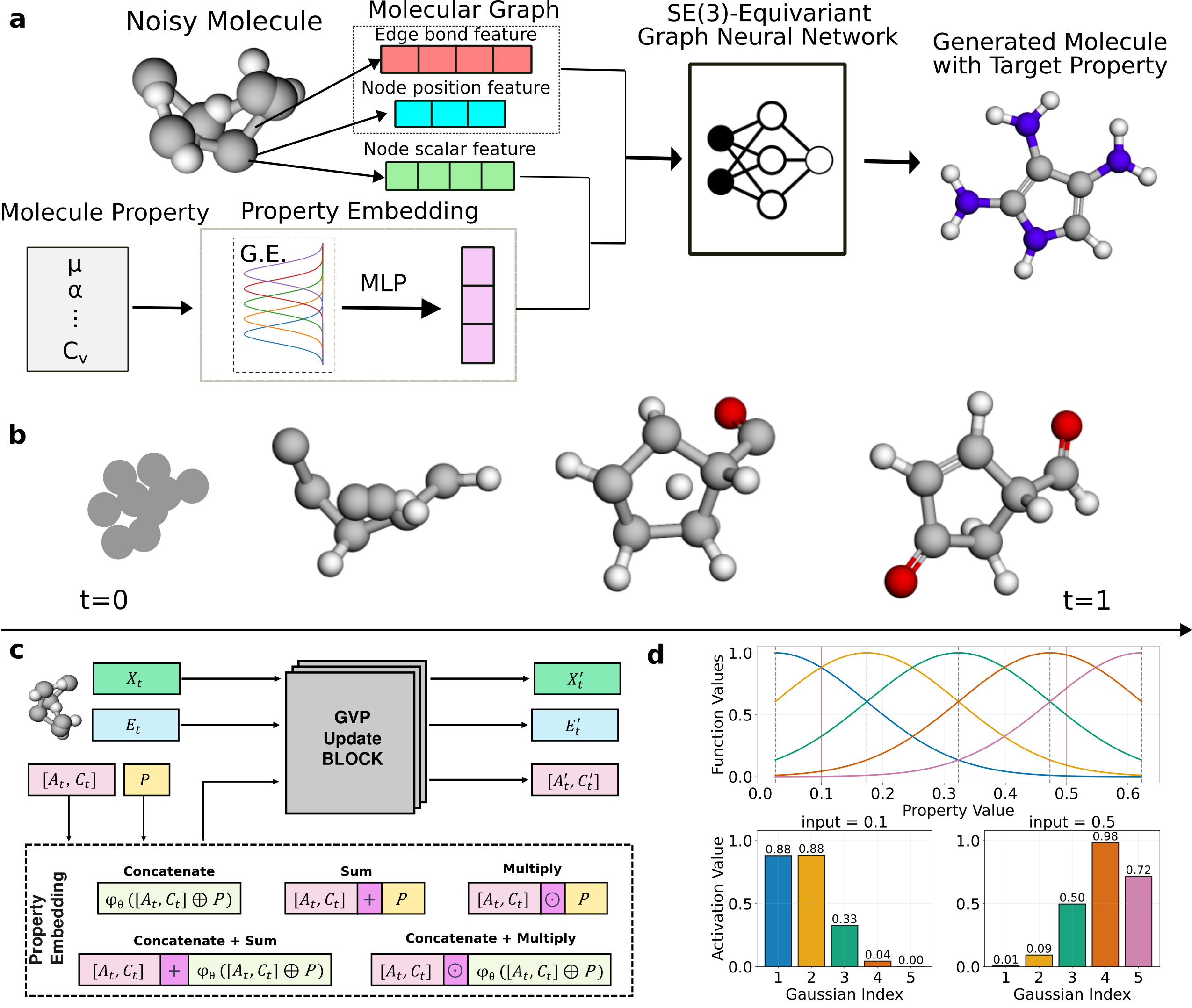
The paper is published at Nature Computational Science (see also the NYU news release). The preprint is on arXiv and the dataset is on zenodo.
MolGuidance: guidance strategies for conditional generation
MolGuidance extends PropMolFlow by integrating three advanced property-guidance strategies (classifier-free guidance, autoguidance and model guidance) into an SE(3)-equivariant flow matching framework for conditional molecule generation.

An early version was accepted at the ICML 2025 GenBio Workshop, and the full paper is published at Journal of Chemical Information and Modeling. The dataset is on zenodo.
MolCrystalFlow: molecular crystal structure prediction
How molecules pack in a crystal determines many properties of molecular materials. MolCrystalFlow generates crystal packings for given rigid-body molecular conformers, combining a hierarchical representation with equivariant Riemannian flow matching. We benchmark it on two open-source datasets against a state-of-the-art generative model for large periodic crystals and against the rule-based Genarris-3 method.

The preprint is available at arXiv. Code is on GitHub and data is on zenodo. I presented this work at the ACS Spring 2026 meeting in the session “Deep Generative Models in Computational Chemistry”.